TL;DR
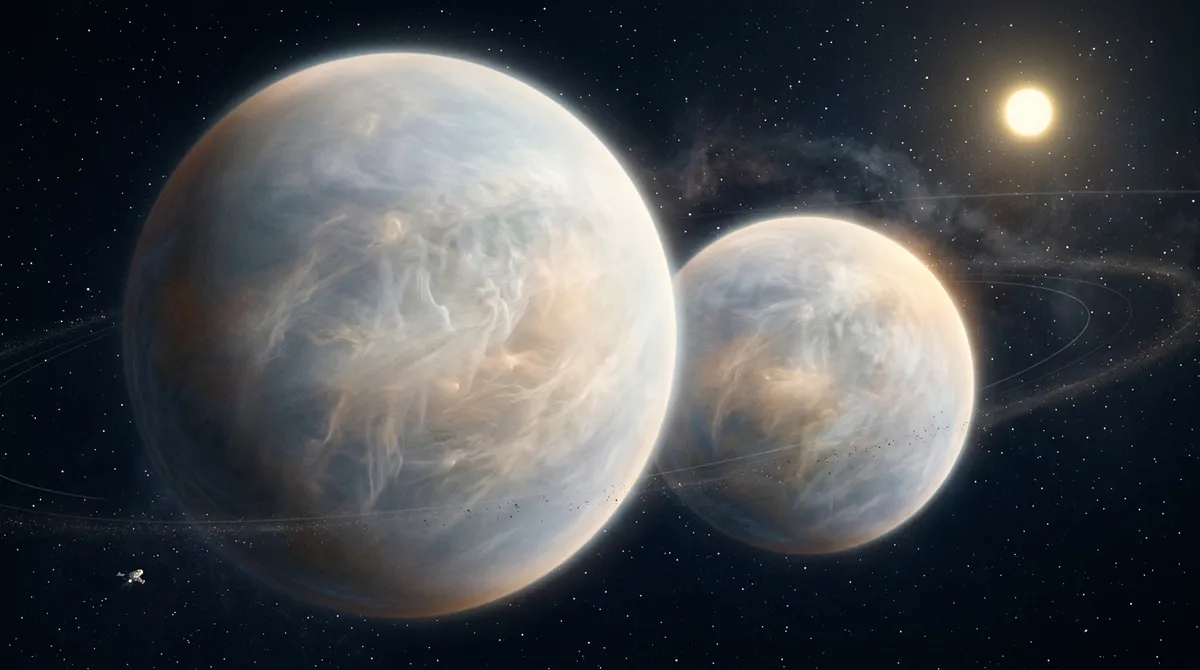
Astronomers have uncovered two bizarre, Jupiter-sized exoplanets called 'super-puffs' with densities even lower than candy floss, sparking intrigue about their unusual atmospheric properties and formation.
What Are 'Super-Puff' Planets?
Imagine a planet so light that it’s denser than candy floss! Welcome to the realm of 'super-puff' planets, a term that defines these extraordinary celestial bodies with densities that leave scientists wide-eyed in disbelief. The recent discovery of two super-puff exoplanets, TOI-791 b and TOI-791 c, has rocked the astronomical community, revealing new insights into how planetary atmospheres can evolve in the depths of space.
The Discovery
An international team of astronomers, led by the University of Liège, employed a blend of advanced tools and citizen science to identify these astonishing planets. Utilizing data from NASA's Transiting Exoplanet Survey Satellite (TESS), combined with observational data from Antarctic telescopes, the team pieced together the puzzle surrounding these exotic worlds.
The Lightness of Being
These super-puff planets are among the lowest density giant planets ever discovered. The duo's densities are so incredibly light that if you were to scoop a bit of them up, they would practically float—imagine the visual spectacle! The cores of these planets are likely composed of gas mixes, mostly hydrogen and helium. This pulsating atmosphere makes them unique laboratory specimens in the search for understanding planetary formation.
Why Are They Significant?
The striking nature of TOI-791 b and TOI-791 c goes beyond their fluffy names. Their discovery presents a momentous opportunity to study planetary atmospheres unlike any we’ve observed.
The Role of Citizen Scientists
A significant aspect of their discovery lies in the contributions of citizen scientists. These volunteers extensively analyzed transit timing and contributed valuable data that made this discovery possible. Just think: everyday people working in tandem with professionals to unravel secrets of the universe! This beautifully illustrates how collaboration can transcend traditional scientific boundaries.
The Antarctic Advantage
Observing these celestial wonders comes with challenges, especially at distances over 1,000 light-years. Antarctic telescopes, however, provide a unique advantage. The high altitude and minimal light pollution create an optimal environment for detailed cosmic observations. This geographical backdrop acted as a launchpad for examining these distant worlds, providing insights that have eluded scientists in other regions.
What Do We Expect from Webb?
The excitement doesn't stop with the discovery. The upcoming observations from the James Webb Space Telescope promise to enlighten the scientific community further. Webb's advanced technology will allow for unprecedented analysis of these super-puff planets, potentially revealing the intricate chemistry behind their bloated atmospheres. Will we discover new elements? Will the atmospheric compounds open doors to understanding other far-off worlds? Time will tell!
Orbital Resonance: A Dance of Planets
Interestingly, TOI-791 b and TOI-791 c exhibit a rare orbital resonance of 5:3. In simpler terms, this means that for every five orbits TOI-791 b completes, TOI-791 c wraps up three. This unusual relationship between the two planets informs scientists about the gravitational interactions that occur in their system and how they influence the planets' atmospheres and potential for hosting life.
Conclusion
The existence of 'super-puff' planets like TOI-791 b and TOI-791 c challenges our understanding of planetary formation and atmospheric evolution. From the role of citizen scientists to the advantages of Antarctic-based telescopes, this discovery encapsulates how humanity collectively pushes the boundaries of cosmic knowledge. With future observations from the James Webb Space Telescope on the horizon, we stand tantalizingly close to unlocking further mysteries of the universe. Who knows what else we may find floating light as a feather in the dark expanse of space? Keep your eyes on the stars!