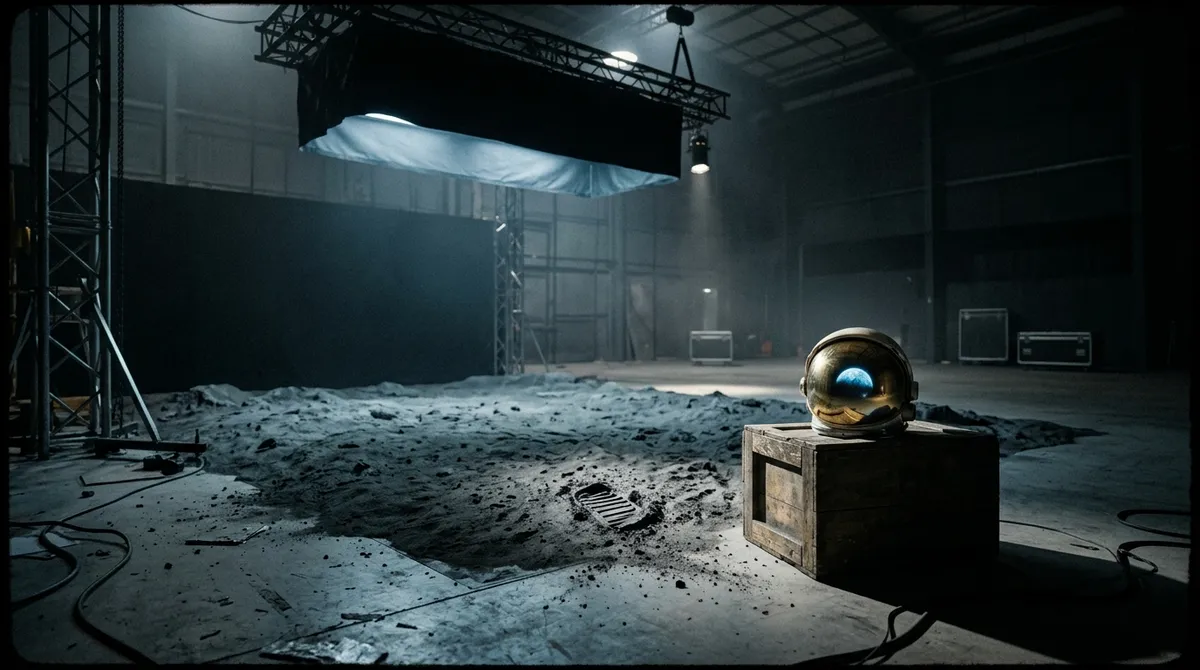
Somewhere between 600 million and 650 million people reportedly watched Neil Armstrong step onto the lunar surface in July 1969. Decades later, a segment of the global population remains convinced they watched the most elaborate hoax in human history. This isn't a fringe whisper anymore — polls have consistently suggested that meaningful percentages of people in multiple countries doubt the moon landings happened as officially described. Here's what the skeptics actually argue, where those arguments break down, and why the conversation refuses to die.
The Core Claims, Laid Out Plainly
Moon landing conspiracy theories generally fall into a few repeating categories. Understanding the specific arguments matters — vague dismissal never killed a conspiracy theory, but precise counter-evidence sometimes does.
The Waving Flag
The most famous visual exhibit: footage from the lunar surface appears to show the American flag fluttering, which doubters argue is impossible in an airless vacuum. Without atmosphere, there's no wind. The flag shouldn't move.
NASA's explanation is straightforward and verifiable by physics: the flag was mounted on an L-shaped rod to keep it extended horizontally, and it moved because Armstrong rotated the flagpole into the lunar soil. Without air resistance to damp it, the flag kept oscillating after being disturbed — actually consistent with a vacuum environment rather than evidence against one. In air, the motion would have stopped faster.
The Missing Stars
Photographs from the lunar surface show a pitch-black sky with no visible stars. To some, this looks like a painted studio backdrop. The photography explanation is mundane but real: cameras set to expose for a brightly sunlit lunar surface use aperture and shutter settings that render a dim background completely dark. Take a photo of a sunlit street — you won't capture faint stars either. It's basic exposure, not deception.
The Stanley Kubrick Rumor
One of the stranger threads in the conspiracy involves director Stanley Kubrick, whose film 2001: A Space Odyssey released in 1968 — one year before Apollo 11 — demonstrated what was then extraordinary simulated space footage. The claim: Kubrick was hired to film fake moon landing footage, and later encoded confessions into The Shining (1980).
This remains speculation with no credible sourcing. Kubrick's daughter Vivian has publicly denied it. The supposed coded admissions in The Shining rely on pattern-matching that researchers in film studies generally characterize as projection rather than intentional messaging. Worth noting: Kubrick was famously obsessed with realism and reportedly complained that 2001 was the one film where he couldn't achieve what he actually wanted visually. Hardly the attitude of a man who'd just successfully faked humanity's greatest achievement.
The Van Allen Radiation Belt
This one carries more technical weight. The Apollo missions passed through the Van Allen radiation belts — zones of intense charged particle radiation surrounding Earth. Conspiracy theorists argue the astronauts would have received lethal doses.
Scientists who study radiation exposure generally respond that the Apollo trajectory was designed to minimize time in the most intense belt zones, and the total estimated dose received was significant but not lethal — roughly comparable to several chest X-rays in the era's understanding, though the actual biological risk was a serious concern NASA engineers worked around. This argument is legitimate enough that it shows up in academic discussions of future deep-space missions, where shielding remains an active engineering problem.
Why the Theory Survives
The moon landing conspiracy didn't emerge from nowhere. It arrived in a specific cultural moment: public trust in U.S. government institutions was actively collapsing. The Pentagon Papers, Watergate, the revelations about COINTELPRO — these weren't paranoid fantasies. They were documented betrayals. If the government lied about those things, the reasoning went, what else?
Bill Kaysing, a former technical writer for a NASA contractor, self-published what's generally considered the founding text of moon landing skepticism in 1974. His background gave the theory a veneer of insider credibility it might not otherwise have carried. The conspiracy spread from there.
The Scale Problem Nobody Solves
Here's where conspiracy theorists face their hardest structural problem. NASA's Apollo program involved an estimated 400,000 engineers, scientists, and technicians. The Soviet Union — locked in direct technological competition with the U.S. and with every incentive to expose a hoax — tracked the missions independently and acknowledged American success. Physicist and author David Grimes modeled in a published paper how long large conspiracies can statistically survive before being exposed by a participant; by his calculations, a fraud on Apollo's scale would have been statistically exposed within years.
None of the 400,000 people credibly came forward. The Soviets never challenged the landing. Retroreflectors placed on the lunar surface by Apollo astronauts are still used by observatories worldwide today — bounce a laser at the right coordinates and it comes back.
What the Doubt Tells Us
The persistence of moon landing conspiracy theories isn't primarily about the moon. It's about institutional trust, and what happens when that trust fractures. The specific claims — flags, stars, radiation — are almost secondary to the underlying conviction that power conceals truth from the governed.
That conviction isn't always wrong. It just, in this particular case, appears to be.