When wildfire smoke fills the sky, you can close the windows, run a purifier, and wait it out. The animals living in the burned country cannot. By the end of this piece, you'll know what a new collar sensor is revealing about the hidden exposure wildlife endure, and why the early numbers are unsettling.
The Story Nobody Was Recording
For all the attention paid to wildfire smoke and human lungs, almost nothing is known about what it does to animals in remote country. Per a report from Phys, that gap is what researchers at Colorado State University set out to close.
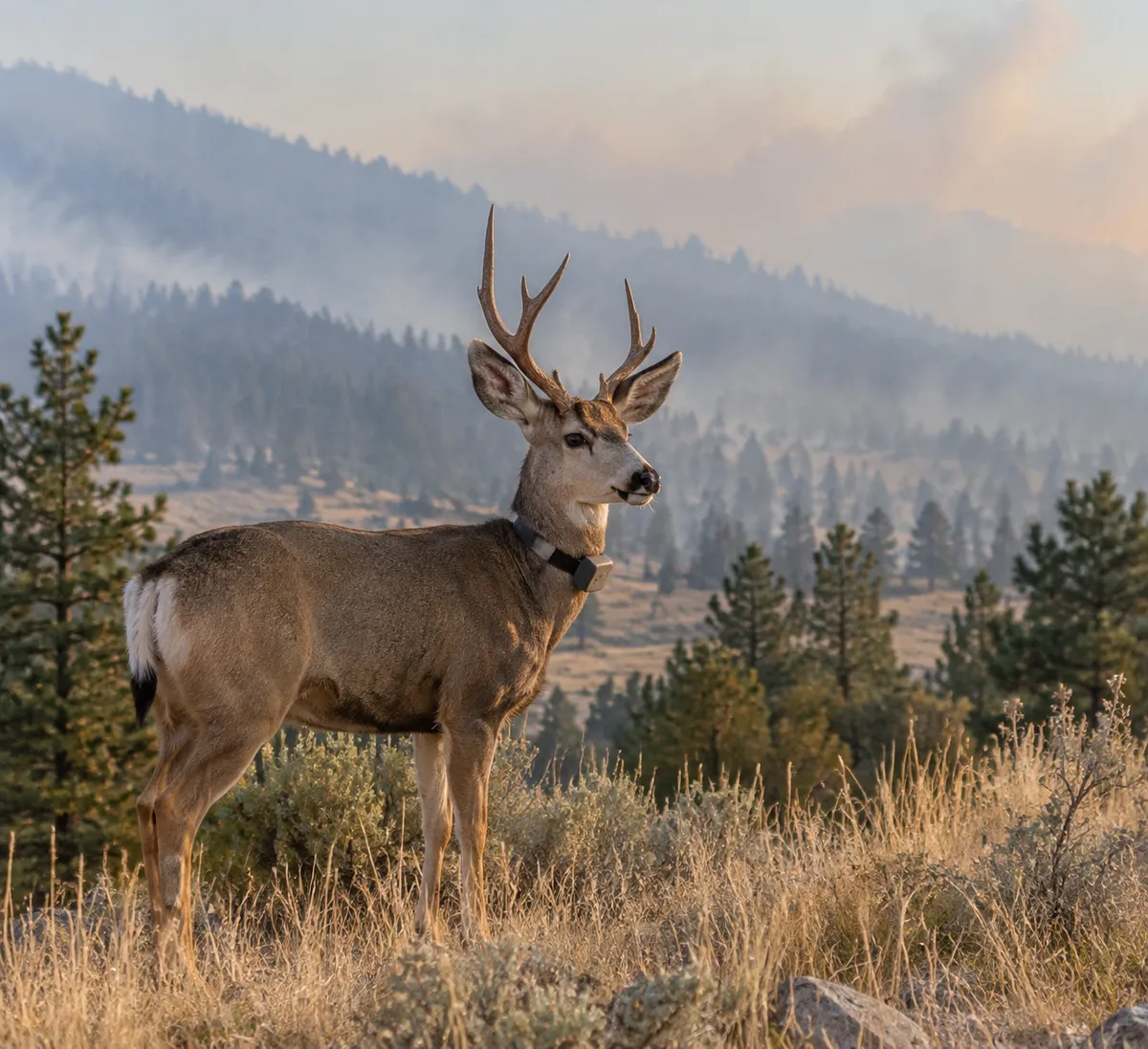
Their tool is a low-cost, open-source device called a "smoke logger." It rides on an animal's collar and measures smoke exposure alongside the animal's location and health data. In effect, it gives researchers a wildlife's-eye view of the air.
Why Wildlife Can't Simply Leave
As wildfires grow more frequent, more severe, and smokier across North America, wildlife face prolonged exposure with few ways to escape it. There is no indoors for a mule deer. Smoke settles into valleys, drifts for days, and the animal just keeps living in it.
That raises a quiet question: what happens to a creature breathing that air for weeks? Until now, scientists have had very little direct evidence to answer it.
A "Fitbit for Deer"
The collar pairs three streams of information:
- Smoke exposure, measured at the animal's own breathing level
- Location, showing where the animal went
- Health data, so exposure can be linked to how the animal fares
That combination matters. Knowing a region was smoky is one thing. Knowing a specific deer stood in it, and how it responded, is another.
The Early Finding: Air Quality Isn't Uniform
The first deployments were on mule deer, and per the Phys report they showed that air quality can vary dramatically at a microscale. That exposes gaps in existing monitoring.
Official air monitors are fixed in place, often far from where wildlife actually roam. If conditions shift sharply across short distances, a distant station may say little about what an animal is breathing. It's hard not to wonder how much smoke exposure has simply gone unmeasured in wild places.
Why Open-Source Matters
The logger is low-cost and open-source. That means other research teams could, in principle, build and adapt it for their own species and landscapes rather than starting from scratch. Cheaper sensors mean more animals tracked, and more animals tracked means a clearer picture of a problem that has mostly lived in the shadows.
What Could Change Because of It
Better animal-level smoke data could shape real decisions. Per the report's framing, it could inform conservation planning and the timing of prescribed burns, so managers can weigh smoke exposure for wildlife, not only for people. It may even sharpen our understanding of human air quality, since the same microscale variation could apply to communities too.
Those are possibilities, not proven outcomes. The work is early, and the deployments so far are limited to mule deer.
The Takeaway
Smoke is an invisible stressor that wildlife have faced without witnesses. Follow this research as it expands, and when you see a smoky-sky warning, remember that the air you can escape is the same air an entire ecosystem is breathing.