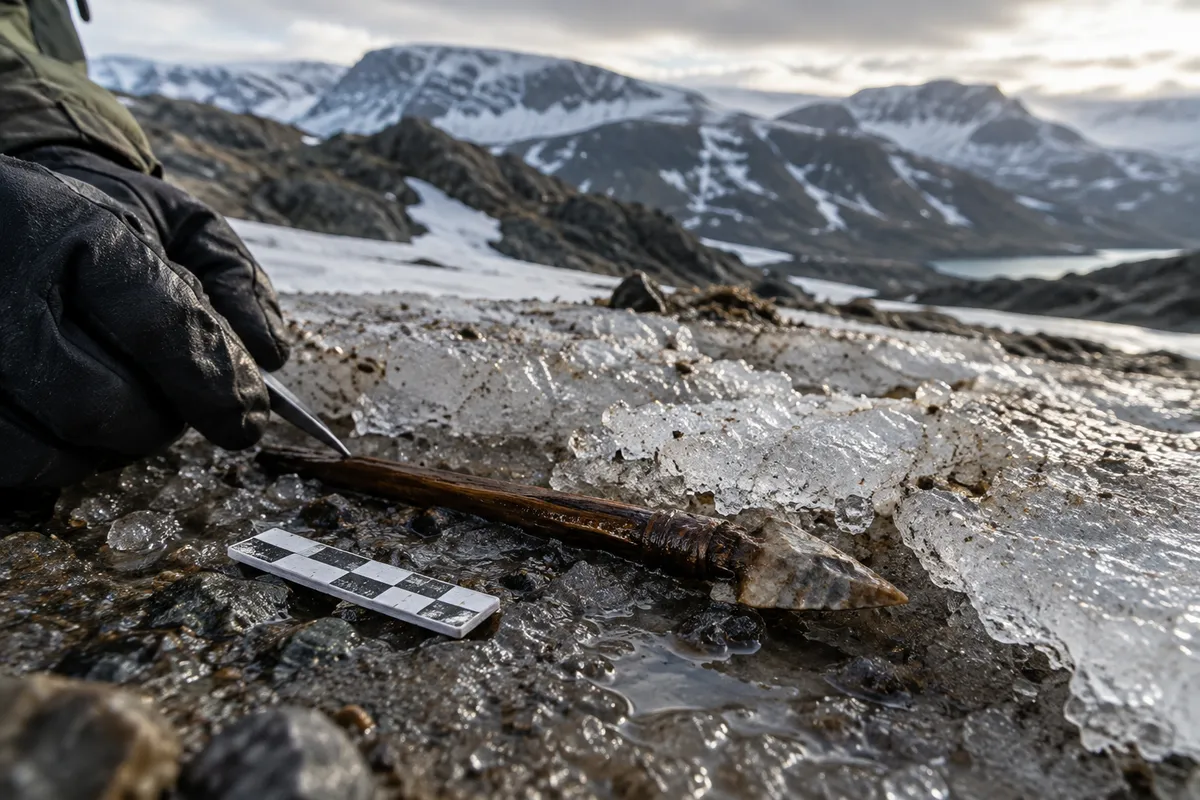
High in the mountains of Norway's Innlandet region, something is surfacing that was not meant to be seen for thousands of years. Arrows. Stone Age arrows, some reportedly 5,000 to 6,000 years old, are emerging as ancient ice patches shrink. By the end of this story, you will understand why archaeologists are both thrilled and uneasy, and why the clock on this evidence is running fast.
The discoveries were reported by Sciencenorway, which describes glacial archaeology in the region being transformed by climate change.
A Frozen Archive That Nobody Planned
Picture a hunter in the mountains thousands of years ago. An arrow misses, or a shaft breaks, or a piece of gear is dropped on a patch of snow. Snow turns to ice. Ice grows over the object and seals it away from air, bacteria and time.
That, in essence, is how ice patches work as archives. Per Sciencenorway's reporting, the same patches that preserved these objects are now melting, and as they retreat, the oldest material is coming back into daylight.
The cruel twist is built into the process. The ice is only giving up its secrets because it is disappearing.
What Is Coming Out of the Ice
The headline finds are Stone Age arrows in the 5,000 to 6,000-year range, according to the report. These are not museum reconstructions or guesses from a scatter of stones. They are objects left by people who walked these mountains and hunted there, then lost pieces of their gear.
The source frames the region's finds as part of a trend: archaeologists are recovering increasingly ancient artefacts as older and deeper layers of ice thaw. The deeper the melt reaches, the older the story gets.
I can only report what the source supports here, so details such as exact counts, sites or materials are best checked in the original Sciencenorway article.
Why the Oldest Ice Matters Most
Ice does not melt evenly or in a tidy order. The surface goes first, then the deeper layers. As researchers described it to Sciencenorway, the shrinking of the patches means that older and older artefacts are being exposed.
That means each warm season may unlock a deeper chapter of the past than the one before. It also means the earliest chapters are the most fragile. Once an object leaves the ice, it is exposed to air, weather and decay. Organic material that sat sealed for millennia can start breaking down quickly.
This is why the work is a race rather than a leisurely dig. Finds have to be spotted and recovered before they rot, scatter or wash away.
A 20-Year Deadline
The most sobering number in the report: researchers estimate many of the artefact-rich ice patches could disappear within the next 20 years.
If that estimate holds, an archive that took thousands of years to build could be emptied within a generation. Whatever is still frozen inside, and nobody can say precisely what, may be found in that window or not at all.
The timing suggests a strange kind of golden age, one that carries its own warning. The same warming that makes the discoveries possible is erasing the place that kept them safe.
What the Hunters Left Behind
An arrow is more than an object. It suggests people moving through high country, hunting, and sometimes losing what they carried. The Sciencenorway report centres on the mountains of Innlandet, and the finds point to long human use of terrain we now think of as remote and empty.
What we have is silence and fragments. The ice does not explain why a given arrow was there. That is the part we reconstruct, carefully, and it is where the story pulls you in: ordinary people, thousands of years ago, leaving traces in a landscape that is now giving them back.
The Uneasy Feeling Behind the Discovery
There is no conspiracy hiding in this ice, and it would be wrong to invent one. The real secret is quieter: the planet was holding a record of human life, and we are only reading it because it is coming apart.
Sciencenorway ties the finds to visible glacier loss and recent climate-linked disasters, which gives the discoveries an emotional edge. Every new artefact is both a gift and a measurement of how much has already melted.
What You Can Take From This
- Ice is an archive. Ice patches can preserve objects that would normally rot away.
- Melt reveals older layers over time. The oldest material emerges last, and it is the most vulnerable once exposed.
- The window is narrow. Researchers estimate many artefact-rich patches could vanish within 20 years.
If this story grabs you, read the original Sciencenorway report, and follow glacial archaeology as it develops. The next arrow to surface may be the oldest yet, and the ice that guarded it may not be there much longer.