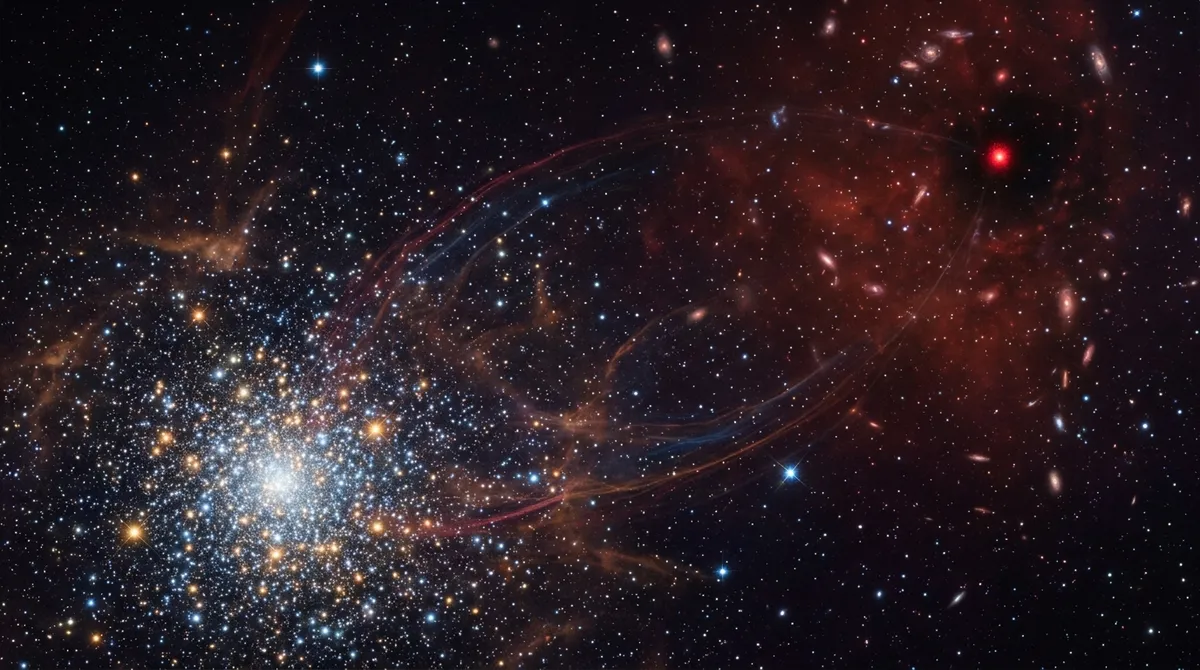
Astronomers at The University of Texas at Austin have proposed a bold new theory centered on the enigmatic Little Red Dots detected by the James Webb Space Telescope (JWST). These compact, red objects spotted in the early universe might not just be random cosmic phenomena—they could actually represent globular clusters still in the throes of formation. This exciting hypothesis could deepen our understanding of the origins of ancient star clusters and their formation processes.
What Are Little Red Dots?
Little Red Dots are distinct objects observed by the JWST, which has fundamentally transformed our understanding of the early universe since its launch. Their peculiar characteristics, including unusual light emissions, timing, and chemical compositions, have puzzled astronomers. Some researchers speculate that these objects could be the precursors to globular clusters, which are dense collections of stars that could provide insight into the universe's formation.
The Monster Star Connection
The heart of the new theory lies in the existence of supermassive stars born inside evolving star clusters. Dubbed "monster stars," these celestial bodies are thought to play a pivotal role in the development of Little Red Dots. According to the researchers, the light, timing, and masses of these red objects are linked to the supermassive stars that briefly shine brightly before their collapse.
These monster stars might leave behind unique chemical signatures that persist across billions of years. In other words, the Little Red Dots could hold the key to understanding not only their own nature but also the entire lifecycle of cosmological structures like globular clusters.
Why This Matters
The implications of this research are monumental. If the theory stands up to scrutiny, it would serve as a two-for-one solution: it would explain the composition and nature of the Little Red Dots and provide clarity on the formation of ancient globular clusters. Understanding these processes is crucial for painting a fuller picture of the universe's early days.
Conclusion
As JWST continues to unveil the mysteries of the cosmos, the connection between Little Red Dots and the formation of globular clusters could reshape fundamental aspects of astronomy. This cosmic detective story, centered on the possibility of observing the birth of globular clusters, invites astronomers and enthusiasts alike to ponder what other secrets the universe might still hold in its vast expanse.