TL;DR
Scientists have detected remarkable 'fingerprints' from a black hole's event horizon, shedding new light on gravitational waves and pushing the boundaries of our understanding of the universe.
What Are Black Holes?
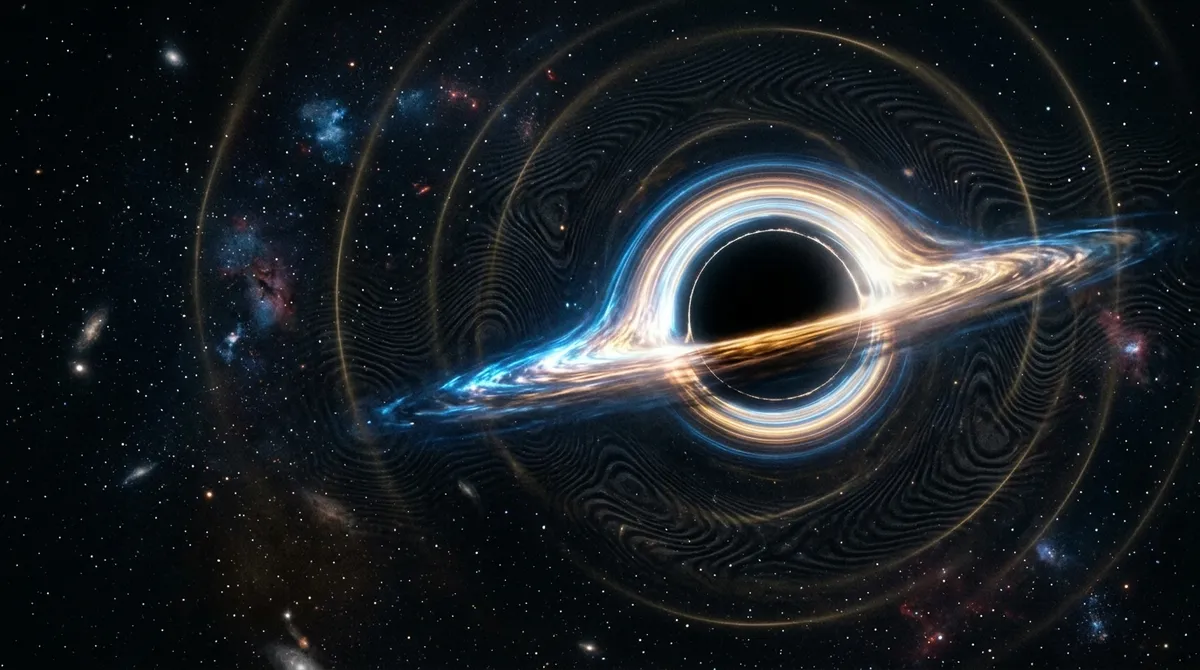
Black holes are one of those cosmic mysteries that tingle the imagination. Picture this: a gravitational point in space so intense that not even light can escape its grasp. The ‘point of no return’ is what scientists call the event horizon. It’s the boundary where all bets are off—once you cross it, there’s no coming back. But now, thanks to groundbreaking research, we have detected what can only be described as 'fingerprints' from these elusive structures.
Gravitational Waves: The Universe’s Soundtrack
Before diving into the findings, let’s talk about how we’re able to 'hear' black holes. Gravitational waves are ripples in spacetime caused by massive events, like the merging of black holes. When two black holes collide, they send out waves that travel across the universe, much like how a pebble creates ripples in a pond. These waves are crucial for scientists as they provide a way to study objects that are otherwise invisible and elusive.
The Groundbreaking Discovery
Researchers examining the merger of two massive black holes, designated GW250114, managed to pick up these gravitational waves and, intriguingly, recognize patterns from the event horizon. This discovery is described as detecting fingerprints because they provide a unique signature that suggests what happens right before matter and light are lost to a black hole. It's a major leap in our understanding of black holes and their event horizons, moving us from mere observation into the realm of investigation of the physics that govern these mysterious entities.
Why This Matters
This scientific breakthrough holds significant implications. By analyzing these fingerprints, scientists can test Einstein’s general relativity in uncharted regions of spacetime. Does Einstein’s theory hold under extreme conditions near a black hole’s event horizon? This research could either reinforce or challenge centuries-old theories about gravity and the very fabric of our universe.
Debating the Findings
But hold on! Not every expert is singing praises. Some researchers are approaching these findings with caution. Skepticism in science is vital; it pushes us to dig deeper. Critics argue that while these footprints suggest exciting possibilities regarding black holes, much of the interpretation still hinges on models that may not fully capture the complexities of such extreme environments. Could these ‘fingerprints’ be a fluke, or do they genuinely represent new physics waiting to be uncovered?
Out into the Quantum Realm
Now, let’s take a trip down a more speculative path: If these fingerprint readings are as significant as they seem, could they lead us to a better understanding of quantum gravity? Scientists have long struggled to unify the forces of nature, and black holes may be the missing link. If we can understand the interplay of gravity at extreme scales, we might just unlock answers that have eluded us for decades. Could black holes actually teach us about the building blocks of reality?
Conclusion: A New Era of Discovery
The detection of fingerprints from a black hole's event horizon is not just another notch in the belt of astrophysics; it's a call to adventure into the unknown. As we stand on the cusp of a new era in gravitational wave astronomy, the possibilities feel endless—and the universe is smiling down at us, eager to reveal more of its secrets. So, hold onto your telescopes and keep your ears to the ground; the cosmos has more to say, and we are only just beginning to listen.