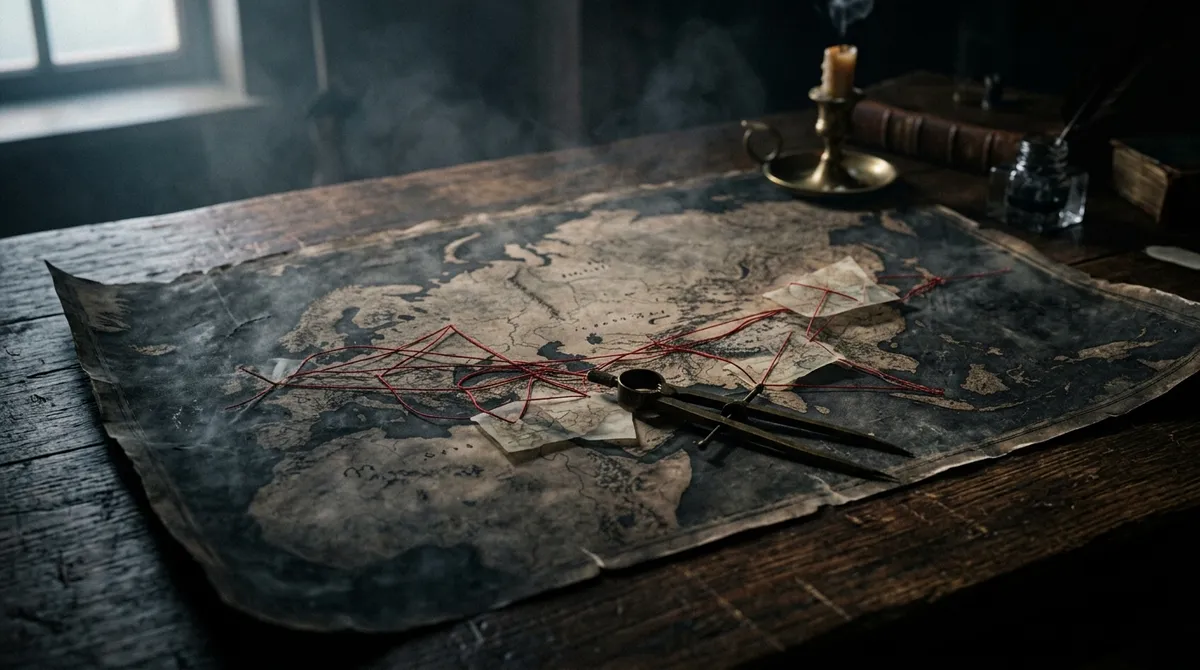
Old maps name it plainly: Tartaria. It sprawls across Eurasia in faded ink, labeled on cartographic documents from the 16th through 18th centuries as if it were a real, functioning empire. For mainstream historians, it was a geographic label for loosely confederated Mongol and Turkic peoples — a catch-all term European mapmakers used for the vast unknown interior of Asia. For a growing community of researchers, amateur historians, and conspiracy theorists, that explanation isn't nearly enough.
By the end of this article, you'll understand the full architecture of the Tartaria theory — the legitimate historical record, the claims that go well beyond it, and why millions of people find the official story deeply unsatisfying.
What the Maps Actually Show
Tartaria — sometimes spelled Tataria — appears on European maps from roughly the 1500s onward. Major cartographers including those working under the Blaeu and Ortelius publishing houses labeled enormous regions of Central Asia, Siberia, and parts of China under variations of this name. Terms like Tartaria Magna (Great Tartaria) and Chinese Tartaria subdivided the territory.
Historians generally agree this reflects the lasting cultural memory of the Mongol Empire and its successor khanates, filtered through European geographic understanding that was, frankly, incomplete. These regions were poorly explored by Western travelers, so mapmakers used broad ethnic-geographic labels rather than precise political borders.
That's the orthodox account. It's documented, sourced, and boring — which is precisely what opened the door for something much stranger.
The Conspiracy: A Civilization Erased
The modern Tartaria theory, which gained serious traction on YouTube and Reddit communities around 2018 onward, proposes something far more dramatic. According to its proponents, Tartaria was not simply a geographic label. It was a vast, technologically advanced global civilization — one that was deliberately erased from the historical record by the powers that shaped the modern world order.
The theory branches in several directions, and not all believers agree on the details. But the core claims tend to include:
The Mud Flood. Believers point to photographs of 19th-century buildings — particularly in Russia, Central Asia, and North America — where the ground floors appear to be partially buried. The argument is that a catastrophic event, often described as a "mud flood," buried the lower sections of Tartarian architecture sometime in the 1800s. Mainstream explanations involve gradual soil accumulation and urban development practices of the era.
Stolen Architecture. The theory holds that grand 19th-century buildings — neoclassical structures, ornate train stations, and government buildings across Europe and the Americas — were not built by the civilizations credited with them. They were inherited from Tartaria and later claimed as original construction. The argument leans on the observation that some of these buildings appear too complex to have been constructed in the timeframes given.
Free Energy and Suppressed Technology. Nikola Tesla appears frequently in Tartaria discussions. Some adherents suggest Tartarian civilization had mastered free energy technology — possibly the same principles Tesla independently rediscovered — and that this knowledge was buried along with the civilization itself.
The Great Reset of History. This strand connects to broader theories about the Romanovs, the Jesuit order, or unnamed elites orchestrating a deliberate rewrite of history — replacing centuries of Tartarian dominance with the sanitized national histories we're taught today.
Where the Evidence Gets Thin
The Tartaria theory runs into serious problems when scrutinized against the archaeological and documentary record.
The buildings cited as "too sophisticated" for their era have construction records, architect biographies, financial ledgers, and contemporary accounts of their building. The buried ground floors in Russian cities align with documented practices of raising street levels and the natural settling of urban soil over centuries — not a sudden catastrophic flood.
The maps themselves, far from being suppressed, are publicly accessible in major archives and have been studied extensively by historians who reached conclusions consistent with the Mongol-Turkic explanation.
Perhaps most critically: a global civilization leaves physical traces that survive mass erasure attempts. Tartaria proponents have not produced artifacts, language records, or genetic evidence that point to a unified advanced civilization occupying these territories.
Why It Resonates Anyway
Dismissing Tartaria believers as simply gullible misses something important. The theory taps into legitimate frustrations — the demonstrable fact that history has been written by winners, that inconvenient evidence sometimes gets marginalized, and that official institutions don't always tell complete truths. Those instincts aren't wrong. They're just being applied to a framework that doesn't hold up under examination.
There is also genuine aesthetic wonder at the core of it. The maps are real. The architecture is breathtaking. The idea that something massive was lost — whether through conquest, catastrophe, or conspiracy — touches something deep in how humans relate to the past.
The Thread Worth Pulling
The actual Mongol Empire was one of history's most underappreciated forces of connectivity, culture, and technology transfer. Its collapse and the subsequent fracturing of Central Asian civilizations genuinely left gaps in the Western historical narrative. That's not conspiracy — it's historiography.
If the Tartaria theory sends people toward primary sources, old maps, and the real history of the Eurasian steppe, it may accidentally do useful work. The version that ends with secret elites and mud floods is where the thread snaps.
Keep the curiosity. Test the claims.