TL;DR
Active supermassive black holes can make exoplanets uninhabitable even at great distances, challenging the traditional view of habitability focused solely on a planet's proximity to its star.
The Cosmic Threat to Habitability
As we look to the stars in search of alien life, the discovery of potentially habitable exoplanets fills us with hope. However, a recent study has introduced a chilling realization: supermassive black holes (SMBHs), located at the heart of galaxies, can significantly impact a planet's ability to support life.
Imagine a thriving planet nestled in what scientists call the "Goldilocks Zone," perfectly poised to sustain liquid water and life. It’s easy to assume that just being in the right spot relative to its star guarantees a habitable environment. But what if that cozy planetary home is under threat from a cosmic giant light-years away?
The Goldilocks Zone: More Complicated than We Thought
Traditionally, the search for habitable exoplanets has revolved around the Goldilocks Zone—the perfect distance from a star where conditions are just right for liquid water. However, this view is becoming increasingly simplistic. New research suggests the influence of vast cosmic forces, like supermassive black holes, must also be considered.
More Than Just Distance from a Star
These black holes can have an expansive reach, affecting planets that orbit far beyond their immediate vicinity. The newfound emphasis on the broader galactic environment reminds us that habitability is a multifaceted issue.
How Supermassive Black Holes Can Render Planets Uninhabitable
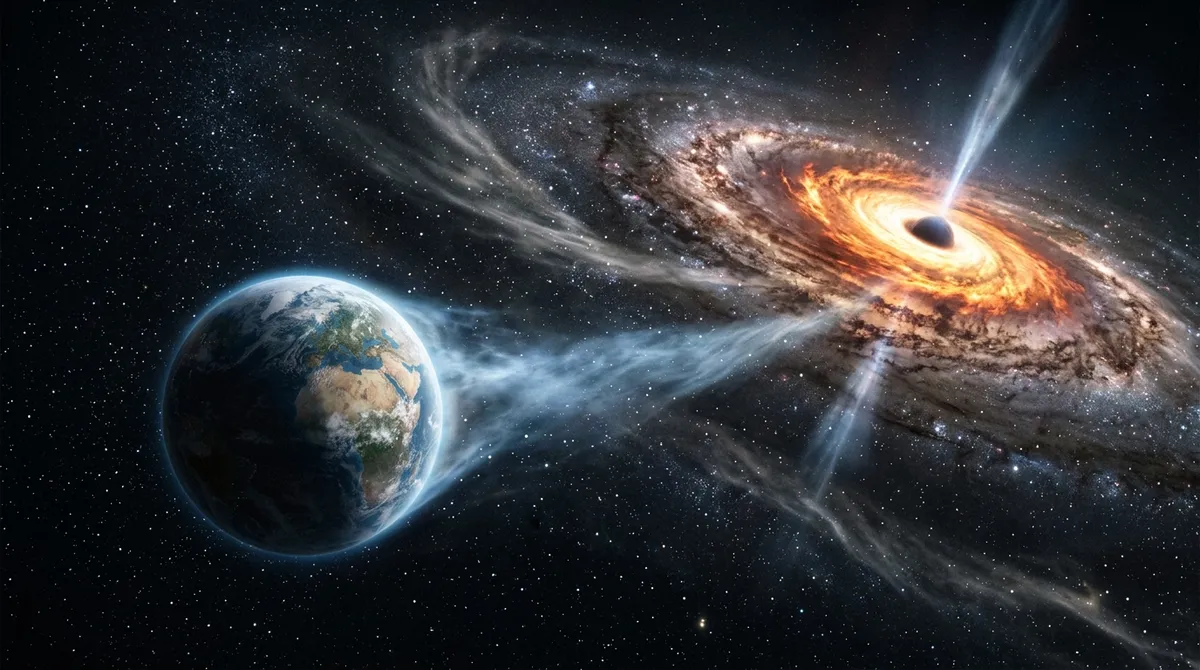
The latest findings indicate that SMBHs emit powerful winds and radiation that can strip atmospheres and deplete ozone layers, rendering exoplanets inhospitable. Let’s break down how this occurs:
Stripping Atmospheres
Active galactic nuclei (AGN) churn out energy that erupts into their surroundings. This energy creates winds that can blow away a planet's atmosphere, particularly those orbiting closer to the galactic center.
Heating Effects
The radiation from these black holes can heat planets to extreme temperatures, potentially boiling away surface water and fostering impossible conditions for life. As researchers dive deeper into the effects of AGN activity, the true dangers of proximity to a black hole become alarmingly clear.
The Galactic Center: A Hostile Environment
The center of a galaxy—often seen as a hotspot of stellar activity—may not be the sanctuary we once thought. Instead, it could be a lethal zone for developing life, with black holes’ influence extending far and wide, creating a challenging environment for planets to thrive.
Energy-Driven vs. Momentum-Driven Winds
Debates abound regarding the types of winds produced by these mighty cosmic beasts. Energy-driven winds are particularly dangerous, as they carry high amounts of energy and can have devastating effects on planets further afield. In contrast, momentum-driven winds tend to weaken with distance. The implications of this variation in wind type add another layer to our understanding of galactic habitability.
Implications for the Search for Alien Life
So, what does this mean for the ongoing search for extraterrestrial life? With these revelations, scientists must expand their criteria for habitability beyond mere proximity to a star. Understanding the dynamics of galaxy centers and their supermassive black holes could provide crucial insights into where to look for life.
Redefining Our Search Parameters
The new exploration criteria require an interdisciplinary approach, blending astronomy, planetology, and astrobiology. As we refine these search parameters, we gain a clearer picture of which distant worlds might actually harbor life—or might be fundamentally hostile.
Conclusion
The discovery that supermassive black holes can impact exoplanet habitability significantly alters our cosmic perspective. As we gaze into the night sky, the fate of distant worlds may hinge on forces far beyond our individual solar systems. The quest for extraterrestrial life is not just about finding a planet in the Goldilocks Zone; it’s about understanding the entire galaxy's role in potentially nurturing or destroying those chances. So the next time you ponder life beyond Earth, remember: it might not just be about the star, but also the shadow cast by the beast at the galaxy's center.