
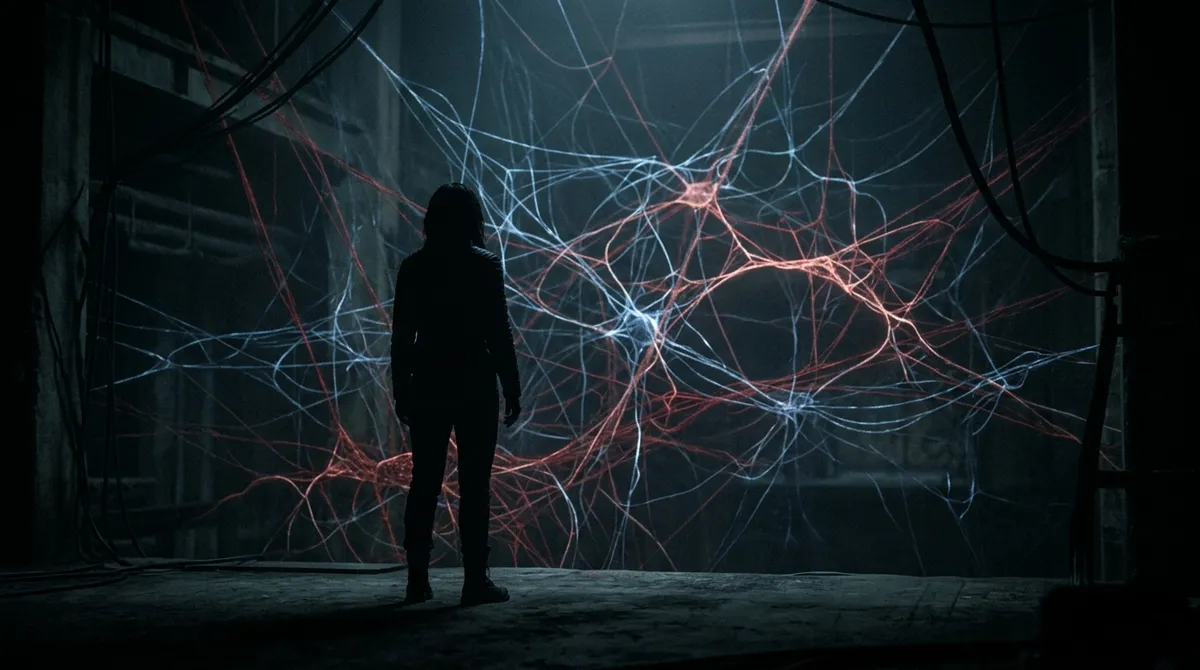
Something is being hidden from you. Someone powerful is pulling strings. The official story doesn't add up.
If those phrases made even a small part of your brain lean forward — that reaction is the whole story. According to research examined by Flinders University, the pull of conspiracy theories isn't a sign of a broken mind. It's a sign of a very human one. By the end of this piece, you'll understand exactly which psychological levers these narratives pull — and why that knowledge matters more than any debunking ever could.
Your Brain Was Built to Find Hidden Patterns
Human brains are pattern-recognition machines. That's not a flaw — it's the feature that kept your ancestors alive. Hear a rustle in the grass, assume predator, survive. Hear a rustle, assume wind, get eaten. Over millions of years, evolution rewarded the brain that connected dots, even when those dots didn't form a real picture.
Conspiracy theories feed directly into that wiring. They offer a complete pattern. Every anomaly, every coincidence, every gap in the official record gets absorbed into the narrative and explained. Nothing is random. Nothing is wasted. For a brain that is uncomfortable with uncertainty, that completeness feels deeply satisfying — almost like solving a puzzle.
Cognitive researchers describe this as apophenia: the tendency to perceive meaningful connections between unrelated things. Conspiracy narratives are essentially apophenia with a storyline. They take the chaos of the world and wrap it in a cause and an enemy. That's not stupidity. That's pattern-matching working exactly as designed, just on the wrong target.
The Three Psychological Needs These Theories Actually Fulfill
The research framing from Flinders University points to something researchers call the three pillars of conspiracy appeal. Understanding them changes how you see the whole phenomenon.
Control and certainty. When events feel random or overwhelming — a pandemic, an economic collapse, a political shock — people experience what psychologists call epistemic anxiety: a destabilizing sense that the world is unpredictable and dangerous. A conspiracy theory resolves that anxiety instantly. If a secret group is behind the chaos, then the chaos is actually ordered. Terrifying, but ordered. That's paradoxically more comforting than randomness.
Meaning and significance. Conspiracy belief also satisfies a need to feel that you matter — that you're one of the people who sees through the lies. This isn't vanity. It's a basic human drive for significance. Knowing the hidden truth, as the narrative frames it, places you in a select group. You're not a passive victim of events. You're awake.
Community and belonging. This is the factor most people overlook. Conspiracy communities are real communities. They share language, rituals, insiders jokes, a shared sense of mission. Leaving the belief system often means leaving the people — which is why simply presenting someone with counter-evidence almost never works. You're not just challenging their ideas. You're threatening their social world.
Why Debunking Backfires
Here's the piece of psychology that trips up well-meaning people most often: confronting a conspiracy believer with facts frequently makes the belief stronger, not weaker. Researchers call this the backfire effect — though its scope is still debated in the literature, the broader principle holds in conspiracy contexts.
When someone's belief is tied to their identity and social group, a direct challenge registers as a personal attack. The brain responds by defending the belief more aggressively, not reconsidering it. Every piece of counter-evidence becomes, within the internal logic of the conspiracy, further proof of how deep the cover-up goes. You showed them a government document that contradicts their claim? Of course the government would produce that document.
This isn't intellectual dishonesty. It's a predictable feature of how beliefs formed around identity actually work. The conspiracy framework is, by design, unfalsifiable — structured so that no piece of evidence can disprove it.
What Actually Works When Talking to a Believer
If debunking is the wrong tool, what's the right one? The research landscape here points toward curiosity over confrontation.
Ask, don't tell. Questions like what would change your mind about this? or how did you first come across this idea? open a reflective space without triggering defensiveness. You're inviting them to examine their own reasoning, which is far more powerful than you examining it for them.
Validate the underlying concern, not the theory. Most conspiracy beliefs are rooted in a real grievance: distrust of institutions, economic anxiety, a feeling of being ignored by the powerful. Those concerns are often legitimate. Acknowledging that separates you from the dismissive response they're primed to expect — and builds enough trust for an actual conversation.
Don't make it a confrontation about their intelligence. The moment someone feels looked down on, the door closes. The goal isn't to win. The goal is to keep the conversation alive long enough for their own critical thinking to do the work.
Be patient with the timeline. People rarely exit conspiracy belief in one conversation. The research is consistent: change happens gradually, often through a trusted relationship over time — not a single devastating fact-check.
Recognizing the Pull in Yourself
Here's the part that most coverage skips: you are not immune. No one is. The psychological needs that conspiracy theories exploit — for certainty, significance, belonging — are universal. The question isn't whether these levers exist in you. They do. The question is whether you've built the habits to notice when something is pulling them.
When you feel an unusually strong emotional satisfaction from a piece of information that confirms your worldview, that's the signal. When a narrative feels too complete — when it explains everything and leaves no loose ends — that's the pattern-recognition machine running hot. Pause there. Ask what evidence would look like if this narrative were wrong. If you can't answer that, the belief may be unfalsifiable — and that's a warning sign regardless of the topic.
The irresistibility of conspiracy theories isn't a character flaw in the people who believe them. It's a feature of human cognition being exploited by narratives perfectly engineered to feel true. Understanding that mechanism is the first step toward thinking more clearly — and talking more usefully — about the most contested ideas in circulation right now.